 English
 中文简体
中文简体Industry News
HOME / BLOG / Industry News / What Is the Purpose of the Evaporator Coil in the Refrigeration System?




An evaporator that is working normally is the reason a refrigerator stays cold, and it is often the first part to suspect when cooling performance drops. The purpose of the evaporator is simple: it absorbs heat from the air or product inside the refrigerated space, using that heat to boil liquid refrigerant into a gas and thereby lower the temperature. The rest of the refrigeration cycle exists to support this heat-removal function.
Content
In a compression refrigeration system, refrigerant moves through four main components. The compressor raises the refrigerant pressure and sends it to the condenser, where heat is rejected. The liquid refrigerant then passes through an expansion device that drops its pressure and temperature. Finally, the cold refrigerant enters the evaporator, where it is exposed to the warm space that needs cooling.
The evaporator is therefore the heat-absorbing side of the system. Its operating pressure is low, typically a few bar-g depending on the refrigerant and the target temperature. At that low pressure, the refrigerant boils at a temperature below the air in the cabinet, so heat moves naturally from the air to the coil. The phrase “low side” in a refrigeration system refers to the evaporator and the suction line back to the compressor.
Three distinct actions happen inside an evaporator:
The phase change is the critical step. When liquid refrigerant evaporates, it consumes a large amount of heat per kilogram, which is why a relatively small coil can remove significant heat. The boiling temperature is controlled by the refrigerant pressure, allowing the evaporator to work at temperatures well below freezing as long as the pressure is low enough.
The evaporator also dehumidifies the space. Moisture in warm air condenses and freezes on the cold coil surface, which is why defrosting is necessary. This water removal is a secondary but important part of the purpose, especially in display cases and cold rooms.
Evaporators can be classified by how air reaches the coil. In a static or natural convection evaporator, the coil is usually mounted along the back wall or inside a freezer liner, and cold air sinks while warm air rises to replace it. Wire tube evaporators, often seen in household refrigerators, fall into this category. They are simple, silent, and reliable, but they need a larger surface area because natural air movement is slow.
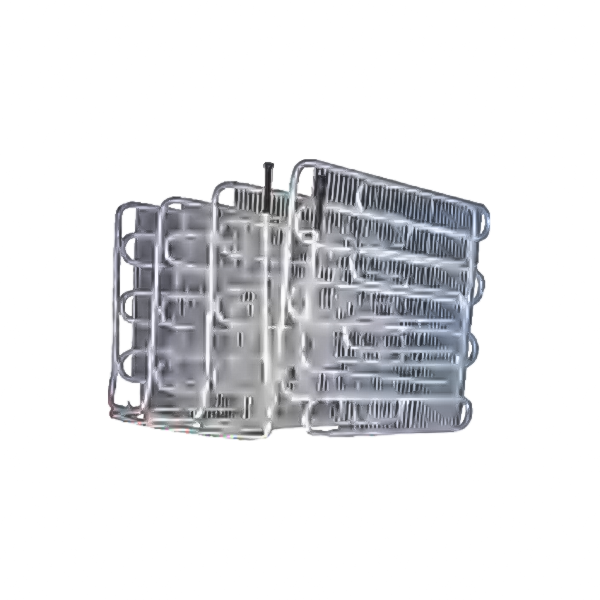 122 Wire Tube Evaporator for Natural Convection SystemsThis evaporator uses a welded steel tube and wire design for static cooling applications. It suits household refrigerators or freezer liners where quiet, reliable operation without forced airflow is needed, offering a simple and cost-effective solution.View Product →
In forced air systems, a fan pushes air over the coil. This is common in commercial refrigerators, freezers, and display cabinets. Fin type evaporators with aluminum or copper tubes provide a large heat transfer surface in a compact package. The fan increases the heat transfer coefficient and shortens the time needed to pull down temperature, but it also introduces more frost accumulation because more air passes over the cold coil.
The choice between these designs affects the defrost schedule, the energy consumption, and the usable storage space inside the cabinet. A static evaporator is quieter and cheaper, while a forced air evaporator gives more even temperature and faster recovery after door openings.
Not every evaporator behaves the same way, even if it fits in the same cabinet. The table below summarizes the variables that have the largest effect on cooling performance.
| Design Variable | Effect on Performance | Practical Note |
|---|---|---|
| Surface area | Higher area increases heat transfer capacity and allows a smaller temperature difference. | Check the rated area against the cabinet heat load, not only the compressor size. |
| Tube diameter and circuiting | Affects refrigerant pressure drop, oil return, and evaporating temperature distribution. | Over-long circuits can starve the far end of the coil and cause uneven cooling. |
| Fin spacing | Wider spacing lets more air flow and reduces frost blockage in low-temperature applications. | Freezers normally need wider fin spacing than coolers. |
| Material | Aluminum fins are light and cost effective; copper tubes resist corrosion and handle aggressive refrigerants well. | Harsh, salty, or humid environments favor copper or protective coatings. |
| Airflow arrangement | Determines whether the coil can evenly cool the entire cabinet. | Match the coil face velocity to the fan curve and duct design. |
These variables are interconnected. For example, a densely finned coil may have a high nominal capacity but can lose much of it in a freezer once frost forms. A well-designed evaporator keeps the air path open for long enough between defrost cycles.
When an evaporator stops doing its job, the usual symptoms are poor cooling, a compressor that runs too long, or ice forming on the coil. Some of the common problems have direct design implications.
Frost and ice buildup are the most frequent issue. If the defrost interval is too long, the ice acts as an insulator and the evaporating temperature drops, reducing capacity. If the coil has narrow fin spacing in a freezer, the problem becomes worse. For cold rooms and freezers, choose an evaporator designed for the expected humidity.
Dirty coils are another concern. Dust and grease on the fins reduce airflow and increase the temperature difference between air and refrigerant. This makes the compressor work harder and shortens its life. Regular cleaning is the cheapest protection.
When corrosion and leaks occur, the tube material is the first thing to examine. Aluminum tube evaporators provide good heat transfer at a lower weight and cost, which is why many refrigeration products use them. For a typical air-cooled evaporator in a clean indoor environment, aluminum is often the most practical choice.
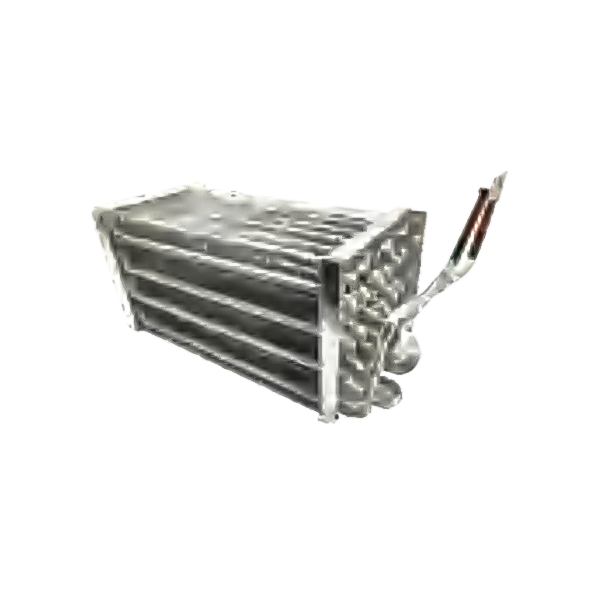 126 Fin Type Evaporator with Aluminum TubesAn all-aluminum fin evaporator with slant-inserted fins, available in lengths up to 600 mm. It provides good heat transfer at lower weight and cost, making it a practical choice for clean indoor environments where corrosion risk is minimal.View Product →
Copper tube evaporators cost more but tolerate harsher conditions. If the unit will be cleaned with aggressive chemicals, installed in a salty coastal location, or used with certain refrigerants that react more strongly, copper gives a wider safety margin.
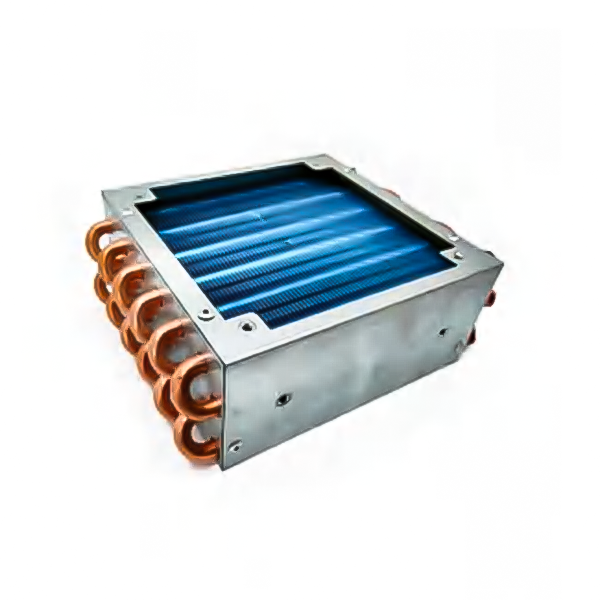 153 Fin Type Copper Tube EvaporatorThis evaporator features copper tubes with smooth or rifled surfaces and aluminum fins. Copper construction offers a wider safety margin in harsh conditions such as coastal areas or aggressive chemical cleaning, helping prevent corrosion and leaks.View Product →
An undersized evaporator creates its own failure mode. If the coil cannot absorb heat fast enough, the cabinet will not reach the target temperature. The compressor may short-cycle or run continuously, and humidity in the cabinet will stay high. Sizing should be based on the evaporator duty at the required temperature, not on a general rule of thumb.
For purchasing and engineering teams, the purpose of the evaporator becomes concrete when it is time to specify a part. Keep these points on the checklist:
Working with a manufacturer that produces both wire tube and fin type evaporators helps in these decisions, because the right choice is usually a trade-off among capacity, cost, and reliability. Our own production line is located in Suzhou, China, and we have manufactured evaporators and condensers for refrigerators, freezers, display cabinets, and water dispensers since 1992. We operate under an ISO9001-based quality system, covering material selection, testing, and after-sales support.
For more detail on how to compare fin type evaporators, see our design selection guide for fin type evaporators. If you are beginning the application work, start with the overview of our product range and then verify the load calculation for your cabinet.
In the end, the purpose of the evaporator is always the same: to transfer heat from the cooled space into the refrigerant so that the space stays at the desired temperature. How successfully it does that depends on the coil design, the material, the airflow, and the surrounding system. A correctly specified evaporator is one of the lowest-cost and most reliable parts in a refrigeration appliance; a poorly chosen one will create problems that appear only after the unit is in service.
Your email address will not be published. Required field are marked*

No.380 Kangyang Rd in the north,HuangdaiTown,Xiangcheng District,Suzhou City,215143

0512-65481378


