



Content
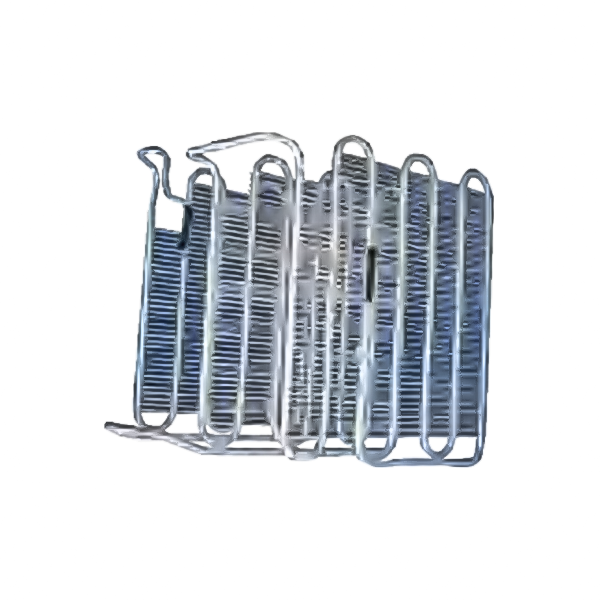
Wire tube evaporators are one of the most widely used heat exchanger designs in small-to-medium refrigeration systems. They consist of a continuous refrigerant tube with steel or copper wires welded perpendicularly along its length, dramatically increasing the surface area available for heat transfer without adding significant bulk or weight. This simple but effective geometry makes them the dominant evaporator type in household refrigerators, freezers, water dispensers, and small commercial cooling units worldwide.
Unlike finned-tube evaporators that require forced air circulation, wire tube evaporators operate effectively through natural convection — the passive movement of air caused by temperature differences alone. This means they require no fan motor, consume no additional electricity for airflow, and have no moving parts to fail. For OEM manufacturers and refrigeration engineers specifying components, wire tube evaporators represent the optimal balance of thermal performance, cost, and longevity for natural-convection applications.
The operating principle is straightforward: liquid refrigerant enters the tube network at low pressure, absorbs heat from the surrounding air as it evaporates, and exits as a low-pressure vapor that returns to the compressor. The welded wire fins conduct heat from the surrounding air into the tube wall, accelerating the heat absorption process.
Each wire attached to the main tube acts as a fin — a secondary surface that extends the heat transfer area beyond the tube wall itself. In a standard wire tube evaporator, the wires are typically spaced 6–12 mm apart and extend 10–30 mm from the tube surface on each side. This geometry can increase the effective heat transfer surface area by a factor of 3 to 6 times compared to a bare tube of the same length. The wires are resistance-welded (spot-welded) to the tube rather than mechanically attached, ensuring reliable thermal contact with minimal resistance at the joint.
Wire tube evaporators are designed for natural convection — the buoyancy-driven airflow that occurs when cold air near the evaporator surface sinks and warmer air from the cabinet interior rises to replace it. This passive circulation is sufficient for the thermal loads encountered in household refrigerators and freezers, where the goal is simply to maintain a stable set-point temperature rather than to achieve rapid cooldown. Forced convection evaporators (fan-assisted finned coils) move substantially more air per unit time and are used where fast temperature recovery is needed, such as commercial display cabinets or blast chillers. For static cooling applications, natural convection wire tube evaporators consume 15–25% less total system energy than comparable forced-convection alternatives, primarily because no fan motor power is required.
The material selection and joining method used in a wire tube evaporator directly determine its corrosion resistance, thermal conductivity, refrigerant compatibility, and service life. Most commercial production uses one of two primary material combinations.
This is the most common construction in high-volume household appliance manufacturing. Low-carbon steel tube (typically 4–8 mm outer diameter with a wall thickness of 0.5–0.8 mm) is paired with steel wire of 1.2–2.0 mm diameter. The assembly is resistance-welded and then epoxy-coated or powder-coated to resist corrosion from moisture and refrigerant oils. Steel-on-steel evaporators are compatible with both HFC refrigerants (R-134a, R-600a isobutane) and the newer HFO blends. They are the lowest-cost option and account for the majority of global production volume.
Copper tube variants offer significantly higher thermal conductivity — copper conducts heat at approximately 385 W/m·K compared to 50 W/m·K for carbon steel. This allows a copper wire tube evaporator to achieve equivalent heat transfer performance with a smaller physical footprint. The trade-off is cost: copper tube evaporators are typically 40–80% more expensive than steel equivalents of the same rating. They are specified in applications where space is constrained or where premium thermal performance is required, such as medical refrigerators, wine coolers, and high-efficiency appliances.
After fabrication, most wire tube evaporators receive a protective surface treatment. Common options include:
Wire tube evaporators are bent and formed into specific geometric configurations that suit the internal dimensions of the appliance they are installed in. The tube layout determines both the refrigerant flow path and the orientation of the wire fins relative to natural convection airflow.
| Configuration | Layout Description | Typical Application | Airflow Direction |
|---|---|---|---|
| Flat panel (single plane) | Serpentine tube runs in a flat grid pattern | Freezer compartment liner, side wall | Parallel to wire fins |
| Wrap-around / U-shape | Tube wraps around three sides of the inner liner | Upright freezers, refrigerator freezer sections | Vertical natural convection |
| Shelf-type (horizontal) | Flat panel mounted horizontally as a shelf surface | Chest freezers, display coolers | Downward cold air stratification |
| Cylindrical / helical | Tube wound in a cylinder or coil | Water coolers, bottle coolers | Radial convection around coil |
| Back-wall mounted | Flat or slightly curved panel on rear cabinet wall | Compact refrigerators, minibar units | Front-to-back natural convection |
The most thermally efficient orientation positions the wire fins vertically so that cold air draining from the fin surfaces follows the natural convection path without obstruction. Horizontal wire orientations can trap cold air between fin rows, reducing the driving temperature difference and lowering effective heat transfer rates by 10–20% compared to vertically oriented equivalents.
Selecting or designing a wire tube evaporator for a specific application requires matching several interdependent parameters to the system's thermal load, operating temperature range, and refrigerant circuit design.
The evaporator's cooling capacity must be matched to the calculated heat load of the cabinet — which includes heat ingress through walls, door opening losses, and heat generated by the product stored inside. For a standard 200-liter household refrigerator, the evaporator must handle a total heat load of approximately 50–80 W under steady-state conditions. Wire tube evaporators for this class of appliance typically have a rated capacity of 80–150 W at a standardized test condition (usually ΔT of 10–12°C between evaporating temperature and cabinet air temperature).
The evaporating temperature — the temperature at which the refrigerant changes phase inside the tube — determines the cabinet temperature achievable. For fresh food compartments, evaporating temperatures of −5°C to −15°C are typical. For freezer compartments, −25°C to −35°C is the normal range. Pressure drop across the evaporator tube circuit must be kept low to maintain system efficiency; excessive pressure drop raises the compressor suction pressure and reduces COP. Designers typically target a pressure drop equivalent to no more than 1–2°C of evaporating temperature loss across the full evaporator circuit.
The internal volume of the evaporator tube circuit determines how much refrigerant charge the system requires. In systems using flammable refrigerants like R-600a (isobutane), minimizing internal volume is important for safety compliance. IEC 60335-2-24 sets charge limits for household refrigerators using flammable refrigerants; most R-600a systems use 30–100 grams of refrigerant, which demands small-diameter tube circuits with carefully optimized lengths. Wire tube evaporators for R-600a systems are typically designed with 4–5 mm outer diameter tubing to minimize total charge while maintaining adequate surface area.
In any refrigeration system where the evaporator surface temperature drops below 0°C and cabinet air contains moisture, frost will accumulate on the evaporator surface over time. Frost insulates the tube and wire surfaces, progressively reducing heat transfer — tests show that a 3 mm frost layer can reduce evaporator efficiency by 20–30%. Wire tube evaporators in household refrigerators are typically defrosted by one of two methods:
Understanding where wire tube evaporators perform best requires comparing them directly against the other principal evaporator designs used in refrigeration systems.
| Evaporator Type | Heat Transfer Rate | Fan Required | Cost | Best Application |
|---|---|---|---|---|
| Wire tube | Moderate | No | Low | Household refrigerators, freezers, water coolers |
| Finned tube (forced air) | High | Yes | Moderate | Commercial cabinets, no-frost refrigerators |
| Plate evaporator | Moderate–High | No | Moderate–High | Chest freezers, ice cream cabinets |
| Roll-bond evaporator | Moderate | No | Low–Moderate | Refrigerator inner liners, thin-profile units |
| Shell and tube | Very High | No (liquid cooled) | High | Industrial chillers, process cooling |
Wire tube evaporators occupy a specific and well-defined niche: they are unmatched in cost-effectiveness for natural-convection applications below 500 W thermal load. Above that threshold, or where rapid temperature recovery is required, forced-air finned-tube or plate evaporators become more appropriate despite their higher cost and complexity.
For procurement engineers and appliance manufacturers evaluating wire tube evaporators from suppliers, several quality indicators separate robust, long-life components from budget units that fail prematurely in the field.
The resistance weld joining each wire to the tube is the primary structural and thermal contact point. Poor welds — indicated by black discoloration, spatter, or inconsistent weld nugget size — result in high thermal resistance at the joint and eventual fatigue failure from thermal cycling. A well-specified wire pull-off force test requires each weld to withstand a minimum of 30–50 N without separation; reputable manufacturers document this in their quality control procedures and can provide test data on request.
Every evaporator shipped for use in a sealed refrigeration circuit should be pressure-tested to at least 2.5–3.0 MPa (25–30 bar) with dry nitrogen before coating and packing. Helium leak testing is used for premium-grade components, detecting leaks as small as 10⁻⁶ Pa·m³/s. Suppliers who cannot provide pressure test documentation or lot traceability for their assemblies represent a significant warranty and field failure risk.
Surface coating quality is tested via salt spray (fog) testing per ISO 9227. A minimum performance standard for appliance-grade epoxy-coated wire tube evaporators is 500 hours of salt spray exposure with no blistering, delamination, or red rust formation. Units intended for coastal or high-humidity environments should be specified to 1,000 hours or above.
In high-volume appliance assembly lines, dimensional variability in evaporators causes fit problems that slow production and increase rejection rates. Reputable suppliers hold overall dimension tolerances of ±2 mm on external dimensions and maintain consistent tube bend radii to prevent kinking, which would restrict refrigerant flow and reduce performance.
Correct installation of a wire tube evaporator is straightforward, but several errors in installation or system design lead to premature performance degradation or component failure.
Wire tube evaporators should be mounted with a minimum clearance of 15–20 mm between the outer wire tips and any adjacent wall or liner surface. Blocking this clearance impedes natural convection airflow past the fins. In back-wall mounting applications, the evaporator is typically spaced off the liner using plastic clips or foam pads that allow air circulation behind the panel as well as in front.
Connections between the evaporator tube and the system's copper refrigerant lines are typically made by brazing or by compression fittings. Brazing with phosphor-copper or silver-phosphor alloy is the preferred method for permanent installations; it produces a stronger, more leak-resistant joint than mechanical fittings and is compatible with all common refrigerants. The joint area must be purged with nitrogen during brazing to prevent internal oxidation, which would contaminate the refrigerant circuit and damage the compressor.
The ongoing global transition away from high-GWP refrigerants has implications for wire tube evaporator specification. Manufacturers must ensure that material choices, lubricant compatibility, and pressure ratings align with current and near-future refrigerant standards.
R-600a (isobutane), with a GWP of just 3, has become the dominant refrigerant in new household refrigerator production globally — it is now used in over 400 million appliances worldwide according to the United Nations Environment Programme. Wire tube evaporators for R-600a systems require no material changes versus R-134a systems; however, the system's total refrigerant charge must be minimized (as noted above), which influences tube sizing choices.
For commercial applications transitioning to R-290 (propane) or lower-GWP HFO blends such as R-1234yf, evaporator pressure ratings must be reviewed, as some HFO blends operate at higher pressures than legacy HFC refrigerants. Wire tube evaporators for these applications should be rated to a minimum working pressure of 2.8 MPa (28 bar) and tested accordingly.
Your email address will not be published. Required field are marked*

No.380 Kangyang Rd in the north,HuangdaiTown,Xiangcheng District,Suzhou City,215143

0512-65481378

 English
 中文简体
中文简体
