 English
 中文简体
Industry News
HOME / BLOG / Industry News / Commercial Freezer Condenser Sizing: Heat Rejection and Selection Guide




A 500-litre commercial chest freezer that held its temperature all spring can start short-cycling the moment summer arrives. The compressor usually gets blamed first. In most cases the real culprit sits at the back of the cabinet: the commercial freezer condenser was chosen from cabinet volume rather than heat rejection duty, and once ambient air passes 32 °C the condensing temperature runs well above the design point. Discharge pressure climbs, capacity drops, and the compressor burns more energy to move less heat.
Specifying that condenser well comes down to four measurable decisions: how much heat it must reject, how air reaches it, what it is made of, and whether it physically fits inside the cabinet. Guesswork on any one of them shows up later as a field failure.
Content
A condenser does not reject the evaporator duty alone. It rejects the heat the evaporator absorbed plus the heat the compressor added while compressing the vapour. For commercial freezers running at low evaporating temperatures that multiplier is significant: design figures commonly land between 1.5 and 1.9 times the evaporator capacity, and the colder the cabinet, the higher the multiplier.
The second number is the temperature difference between the condensing temperature and the surrounding air. Air-cooled condensers for commercial cabinets are usually selected for a 10 to 15 K difference. At 32 °C ambient that puts the condensing temperature at roughly 45 to 50 °C, and each extra kelvin above the design point adds roughly 2 to 3 percent to compressor power.
| Cabinet class | Typical evaporating temperature | Heat rejection factor | Condenser temperature difference |
|---|---|---|---|
| Frozen display cabinet | -10 °C | 1.4 to 1.6 | 10 to 12 K |
| Chest freezer | -20 °C | 1.6 to 1.8 | 12 to 15 K |
| Low temperature storage | -25 °C | 1.7 to 1.9 | 12 to 15 K |
| Ice cream cabinet | -30 °C | 1.8 to 2.0 | 12 to 15 K |
Undersizing compounds itself: a higher condensing temperature reduces refrigerant mass flow through the capillary, running hours lengthen, the compressor gets hotter, and the condensing temperature climbs again. Oversizing is gentler, but it is not free — extra material, extra charge and a larger mounting footprint inside a cabinet that is already tight.
Wire tube condensers are the workhorse of household and commercial freezing. A copper tube is bent into a serpentine and steel wires are welded across it at right angles. Single-layer versions suit narrow cabinets where depth is limited; multilayer versions stack two or three passes to pack far more surface area into the same footprint, which matters when a chest freezer needs more capacity without more wall space.
Tube-on-plate condensers bond the serpentine tube to a flat steel plate. The plate spreads heat sideways as well as away, so the surface temperature stays more even, and the plate itself often forms part of the cabinet skin. This style suits designs where the condenser must sit flush against a cabinet wall and no fan can be fitted.
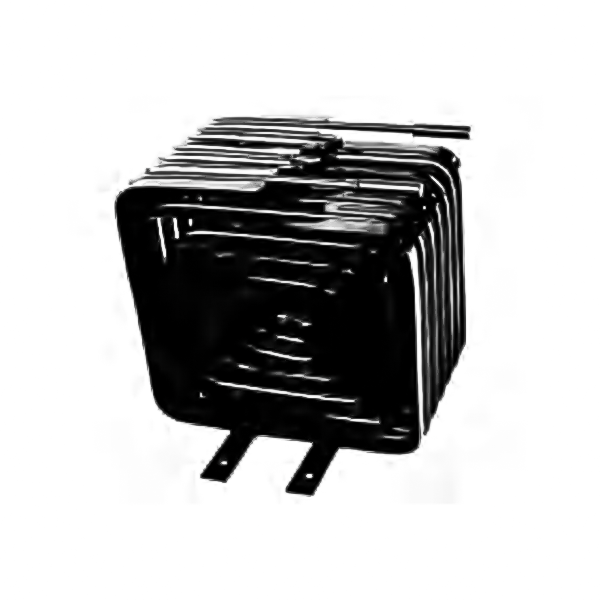 Tube-on-Plate Condensers for Compact Refrigeration CabinetsExplore custom tube-on-plate condenser models 082–093 for refrigerators, freezers, and display cabinets, suited to flush, fan-free cabinet-wall layouts.View Product →
Louvered variants, the window blind type, cut angled openings between the tube runs. The louvers add surface area and break up the air boundary layer, which lifts performance at the low air velocities typical of natural draft. Rotary wing designs take a similar approach with an angled wire geometry that keeps air in contact with the tube for longer.
Internal condensers are built into the machine compartment rather than mounted on an outer wall. They rely on the compartment's own air path, so the vent openings in the cabinet have a direct effect on how well they perform.
Most commercial freezers under roughly 400 litres use a static condenser. Cooling depends on the chimney effect: air warms against the tubes, rises, and is replaced by cooler air from below. Static designs need about 50 to 75 mm of clearance behind and above the condenser, open airflow at the bottom, and no obstruction at the top. Push the cabinet into a corner with 20 mm of clearance and effective capacity can fall by a third.
Static operation has a second consequence that rarely appears in datasheets: the cabinet surface next to the condenser can sit 15 to 20 K above ambient, which is a cosmetic complaint at best and a corrosion problem at worst.
Fan-assisted condensers move far more air and achieve three to six times the heat flux per square metre of face area, allowing a smaller coil for the same duty. The trade-offs are a component that fails, a noise source, and a cleaning obligation. Fin spacing matters here: 4 to 6 mm pitch tolerates dusty back-of-store conditions and brush cleaning, while a tighter 2 to 3 mm pitch performs better but clogs faster.
 045 Wire Tube Condenser (Multilayer) for Refrigeration SystemsReview the 045 multilayer wire tube condenser for R134a/CFC systems, with electrophoresis coating, ≥5 mm wire pitch, custom drawing production, and leak-tested construction.View Product →
Mechanical fit is where sound thermal designs fail at tooling stage. The points worth confirming before a drawing is released: available width, height and depth; the position and direction of the inlet and outlet connections; the bend radius the tube can tolerate without flattening; where the brazed joints will sit relative to insulation; and whether service access lets a brush or vacuum nozzle reach the finned surface after five years in the field.
Internal condensers add one more constraint — the compartment must actually exchange air. Sealed machine compartments trap heat, and a coil rated at 300 W behaves like a 200 W unit once that air stabilises 10 K above room temperature.
 Built-In Condensers Used Inside Refrigeration AppliancesBrowse 116–121 built-in condenser models for refrigerators, freezers, water dispensers, and display cabinets, intended for internal compartments where airflow and heat exchange must be considered.View Product →
Standard construction pairs copper tubing with welded steel wire or aluminium fins. The weak point is the copper-to-aluminium junction, where moisture and salt form a galvanic couple. In coastal installations or cabinets that are washed down regularly, an electrophoretic or epoxy coating of 15 to 25 microns plus a salt spray test result is worth asking for rather than assuming.
Refrigerant choice drives pressure rating and tube wall thickness. R134a and R290 systems for display freezers run at moderate pressures, while R404A, R448A and R449A condensing units sit higher. Transcritical CO2 is a different design envelope entirely and should never be handled by reusing a wire tube condenser drawing.
A mounting hole tolerance of 1 mm is normal; 3 mm is not, because it becomes a rework station on the assembly line. Treat the leak test specification the same way — a pressure hold test alone will not find a marginal braze that a helium test will.
Condensers rarely fail suddenly. They lose capacity as dust and grease build on the surface; a layer only half a millimetre thick can cut performance by 10 percent or more. On the cabinet it shows up as a discharge pressure that keeps climbing, current draw above nameplate, and pull-down times that stretch after every door opening.
Cleaning intervals should follow the environment, not the calendar. A condenser behind a bakery counter needs attention monthly; the same part in a climate-controlled aisle may be fine twice a year. Refrigerant-side faults — a blocked capillary, moisture in the circuit, a restricted filter drier — mimic condenser problems closely, so readings on both sides of the system are worth taking before any part is replaced.
If a cabinet is already in service and running hot, a maintenance check is a cheaper first step than a replacement: practical insights into refrigerator condenser maintenance and efficiency covers the checks worth running before committing to a new coil.
Commercial freezer condensers sit where thermal design, cabinet tooling and field service meet, which is why the specification deserves more than a line on a bill of materials. A manufacturer that also builds the matching evaporators usually settles duty, charge and connection layout in one conversation rather than three.
Suzhou Yikangda Electrical Appliance Co., Ltd. has produced condensers and evaporators since 1992, has held ISO 9001 certification since 2001, and builds wire tube, tube-on-plate, louvered, rotary wing and internal condensers across roughly 140 models. You can review the full range on the condenser and evaporator product index.
Your email address will not be published. Required field are marked*

No.380 Kangyang Rd in the north,HuangdaiTown,Xiangcheng District,Suzhou City,215143

0512-65481378


