 English
 中文简体
中文简体Industry News
HOME / BLOG / Industry News / China Air-Cooled Condensers Manufacturer: Sourcing Guide for OEM Buyers




A refrigeration engineer in Italy sends the same drawing to three condenser factories in China: a wire tube condenser for a 1.6 m commercial display cabinet, natural draft, no fan, copper tube, painted steel wire. The drawings are identical. The quotations are not. The gap rarely comes from the price of steel. It comes from tube wall thickness, wire pitch, brazing quality, paint adhesion, and how many units are actually leak tested before they are packed.
The conclusion first: buying air-cooled condensers from a China manufacturer goes smoothly when you fix three things before you talk about price. Structure type, material grade, and process evidence. Unit cost follows from those three decisions, not the other way around.
Suzhou Yikangda Electrical Appliance Co., Ltd. has been designing and producing condensers and evaporators for refrigeration appliances since 1992, and has worked under an ISO9001 quality system since 2001. Its catalogue covers wire tube condensers, tube-on-plate condensers, built-in condensers, and fin type evaporators in both aluminum and copper. That catalogue is also a useful map of the decisions a buyer has to make.
Content
An air-cooled condenser rejects heat from the refrigerant to the surrounding air. There is no water loop, no cooling tower, and no secondary circuit to maintain. In refrigerators, chest freezers, display cabinets, coolers and water dispensers, that heat rejection happens in one of two ways.
Natural draft condensers rely on buoyancy and radiant heat. Wire tube condensers, single layer or multilayer, belong to this group. They are welded to the back or side of the cabinet, carry no moving parts, and make no noise. Their limitation is that performance depends on an open rear clearance, which is not always how a shop installs a display unit.
Forced draft condensers use a fan to push air across a finned surface. They handle higher heat loads in a smaller footprint, but they add a motor, a noise source, and a fin block that collects dust.
Getting this choice wrong shows up late. A cabinet can pass a pull-down test in a 25 degrees Celsius room and still fail in a 40 degrees Celsius kitchen, because the condenser was sized for the test room rather than the installation site.
Most Chinese condenser catalogues are organized by structure rather than by heat rejection capacity. That is practical, because structure determines mounting, airflow, and how the part survives defrost cycles, cabinet movement and ocean freight.
| Structure | How it is built | Typical position | Check before ordering |
|---|---|---|---|
| Wire tube, single layer | One serpentine tube welded to a single plane of steel wire | Rear wall of refrigerators and small freezers | Wire pitch, weld penetration, paint coverage between wires |
| Wire tube, multilayer | Two or more tube planes combined in one frame | Rear or side of larger freezers and display cabinets | Layer spacing, tube length per layer, effective surface area |
| Tube on plate | Tube bonded or welded to a flat plate | Cabinet surfaces where a flat face is required | Contact along the full tube length, plate thickness |
| Window blind tube on plate | Tube on plate with louvred openings | Narrow cabinets with restricted airflow | Louvre angle and spacing, burr removal |
| Rotary wing type | Tube arranged in a compact wing pattern | Appliances with tight internal space | Overall envelope, bracket position, support at bends |
| Condenser used inside | Built-in unit designed to sit within the cabinet | Inner walls, recessed channels, hidden cavities | Clearance to insulation, condensation risk, service access |
Wire tube and tube-on-plate types solve different problems. A wire tube condenser exposes a large surface to free air at low material cost, which is why it dominates refrigerator and freezer production. A tube-on-plate unit trades some surface area for a flat, predictable mounting face, which matters when the condenser must sit against a cabinet wall or inside a foam-filled structure. If you are weighing the two, this explanation of how a tube-on-plate condenser differs from a wire tube condenser covers the practical differences.
Multilayer wire tube condensers are the workhorse for larger cabinets. Stacking two or more tube planes into one frame raises surface area without lengthening the cabinet footprint, but it also raises the importance of consistent layer spacing. If the spacing drifts during welding, the air path in the middle layers narrows and the extra surface area delivers less than the drawing promised.
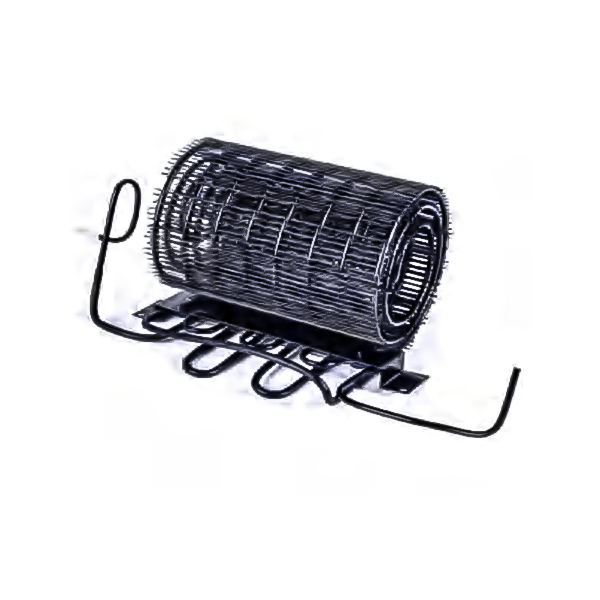 030 Multilayer Wire Tube Condenser for Refrigeration AppliancesMultilayer wire-tube condenser for larger refrigeration cabinets, customizable to drawings or samples with electrophoresis coating and cleanliness for R134a and CFC systems.View Product →
Three inputs decide the specification, and all three should come from the appliance design, not from the factory's standard list.
The first is heat load at the design ambient. A temperate-market refrigerator is typically rated near a 32 degrees Celsius ambient; a tropical unit near 43 degrees Celsius. The condenser that satisfies the first will be undersized for the second, and tube length added at the last minute will not fix a wrong airflow assumption.
The second is the mounting interface. Bracket positions, bend radius, and clearance to the compressor compartment are fixed by the cabinet, so the condenser drawing has to match them within the tolerance the assembly line can absorb. A bend that is 2 mm out of position is enough to stop a fixture from closing.
The third is refrigerant and environment. R600a, R134a and R290 systems charge differently and behave differently at high condensing pressure, and a unit installed in a humid coastal market needs more paint coverage than one sold inland. Built-in condensers add a further constraint set: clearance to insulation, condensation risk on cold surfaces, and access if the circuit is opened in the field.
 116 Flat Wire-on-Tube Condenser for Inside Refrigeration AppliancesFlat wire-on-tube condenser for inside refrigeration appliances, available in galvanized steel or aluminum tube and galvanized or PVC painted, with R134a/CFC cleanliness.View Product →
Buyers who source condensers usually need evaporators from the same supplier, and ordering both from one factory removes a layer of thermal mismatch. The choice between aluminum and copper fin type evaporators is mostly about environment and cost.
Aluminum tube fin evaporators are lighter and cheaper, and they are the standard answer for many domestic refrigerators and freezers. They are also more sensitive to handling damage and to certain forms of corrosion in aggressive atmospheres. Copper tube fin evaporators cost more per unit, but they tolerate higher working pressures, resist corrosion better, and are easier to repair in the field.
Wire tube evaporators cover a third case: where the evaporator is mounted flat against a liner or wall and forced airflow is not available. Fin pitch, tube diameter, circuit length and the defrost method all have to be agreed at the drawing stage, because these parameters cannot be adjusted once the tooling is made.
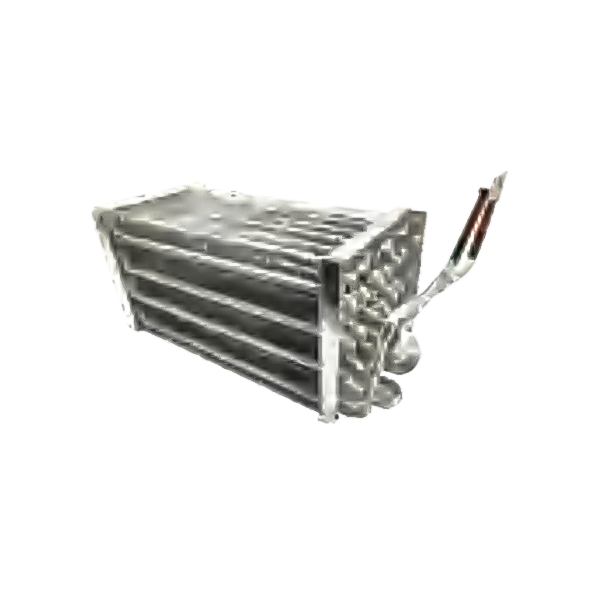 126 Aluminum Fin Type Evaporator for Refrigeration Heat ExchangeAluminum fin heat exchanger evaporator with slant-insertion and straight-row configurations, hydrophobic fins, adjustable fin pitch, and support for customer salt spray requirements.View Product →
A sample that meets the drawing is the minimum standard. The useful question is whether the twentieth unit will also meet it. These checks separate a factory that can hold a process from one that can build one good part.
Condensers are bulky and light, which makes freight a larger share of landed cost than most buyers expect. Location matters more than it does for dense components.
The Suzhou factory sits 1.5 km from the Shanghai-Nanjing expressway entrance, 80 km from Hongqiao airport and its port area, 10 km from the Beijing-Shanghai railway station, and 120 km from the Shanghai seaport. That configuration supports container shipments to Europe and North America as well as consolidated air freight for samples and urgent replacement orders.
Packing is where transit damage usually starts. Wire tube condensers should arrive as nested frames with the tube bends protected, because a bent return bend changes the refrigerant charge the cabinet needs. Ask for the pallet pattern and container fill rate in writing, and confirm whether the carton is designed for a single drop or for stacking three high in a warehouse.
A shortlist of three suppliers is usually enough. The screening questions are the same every time.
Price still matters, and it should be compared on the same drawing, the same material grade and the same inspection regime. Once those are aligned, the numbers become comparable and the conversation moves from negotiation to engineering. Buyers who want to review the hardware before requesting a quote can start with the company's condenser and evaporator product range, which lists the structures described above by model number.
Your email address will not be published. Required field are marked*

No.380 Kangyang Rd in the north,HuangdaiTown,Xiangcheng District,Suzhou City,215143

0512-65481378


