



Content
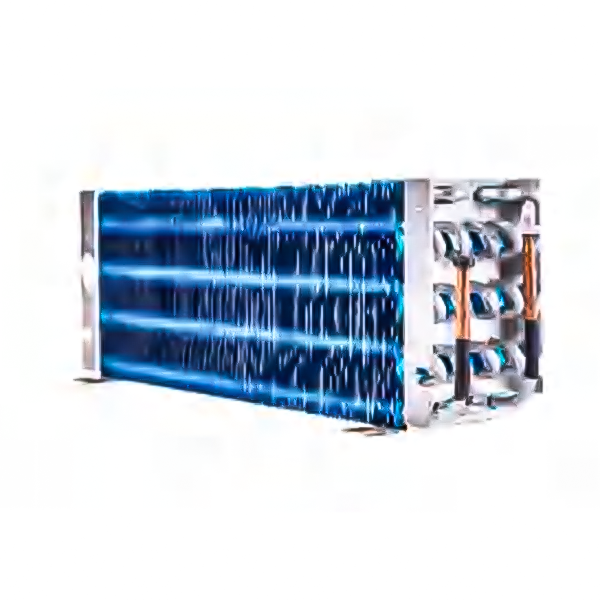
Aluminum tube fin type evaporators are heat exchangers used in refrigeration and air conditioning systems to absorb heat from the surrounding air or a process fluid by evaporating a refrigerant flowing through their internal circuits. The defining structural feature is a matrix of aluminum fins mechanically bonded to aluminum or copper refrigerant tubes — the fins dramatically increase the external surface area available for heat transfer, enabling a compact unit to achieve heat exchange capacity far beyond what the bare tube surface alone could provide.
The operating principle is straightforward: low-pressure refrigerant enters the evaporator in a partially liquid state through an expansion device. As warm air (or fluid) passes over the finned surface — driven by a fan or pump — heat transfers from the air into the refrigerant, causing it to evaporate and absorb latent heat. The now-gaseous refrigerant exits the evaporator and returns to the compressor to complete the refrigeration cycle. The efficiency of this process depends critically on the evaporator's heat transfer characteristics, airflow distribution, refrigerant circuit design, and the thermal properties of its construction materials.
Aluminum has largely displaced copper as the dominant tube material in tube fin evaporators over the past two decades, driven by significant cost advantages (aluminum is approximately 60–70% less expensive per kilogram than copper), weight reduction (aluminum's density is roughly one-third that of copper), and corrosion resistance improvements from alloy development and surface treatment technologies. All-aluminum evaporator coils — using aluminum tubes bonded to aluminum fins — are now the industry standard across residential air conditioning, commercial refrigeration display cases, and industrial process cooling.
The thermal and hydraulic performance of a tube fin evaporator is determined by the interaction of multiple geometric and material design variables. Understanding these variables enables engineers and procurement specialists to evaluate competing products on a technically meaningful basis rather than relying solely on nameplate capacity ratings.
Refrigerant tubes in aluminum tube fin evaporators are produced in two primary configurations. Round tubes — typically 7mm to 16mm outer diameter — are the traditional standard, mechanically expanded into the fin collar after assembly to ensure intimate metallic contact and low thermal resistance at the tube-fin junction. Microchannel (multiport extrusion) tubes — flat aluminum extrusions containing multiple parallel internal channels of 0.5–1.5mm hydraulic diameter — represent the newer parallel-flow architecture that has gained substantial market share in automotive, mini-split air conditioning, and compact commercial refrigeration applications. Microchannel designs offer 20–40% lower refrigerant charge requirements and 10–20% higher heat transfer efficiency per unit volume compared to round tube equivalents, at the cost of higher sensitivity to airside fouling and more complex repair procedures in field applications.
Fins are stamped from aluminum foil (typically 0.09–0.20mm thick) into profiles that range from plain flat fins to complex enhanced geometries — wavy, louvered, lanced, and slit fins — each designed to disrupt the thermal boundary layer that builds up along the fin surface and reduces local heat transfer coefficients. Louvered fin geometries are the current industry standard for air conditioning evaporators, offering heat transfer enhancement factors of 1.5–2.5 times that of plain fins at equivalent airside pressure drop — enabling smaller coil face areas for a given capacity, or reduced fan power for equivalent performance.
Fin pitch — the center-to-center spacing between adjacent fins, typically expressed in fins per inch (FPI) or fins per meter — is a critical design parameter that balances heat transfer surface density against airside pressure drop and frosting susceptibility. Evaporators operating above 0°C coil temperatures (air conditioning and medium-temperature refrigeration) typically use 10–14 FPI; evaporators operating below 0°C (freezer applications and low-temperature display cases) use wider fin spacing of 4–8 FPI to provide adequate space for frost accumulation between defrost cycles without blocking airflow.
The refrigerant circuit — the path through which refrigerant flows from inlet to outlet within the evaporator — determines the uniformity of refrigerant distribution across the coil face and the pressure drop experienced by the refrigerant. Multi-circuit evaporators divide the refrigerant flow into parallel paths through a distributor, reducing refrigerant-side pressure drop and improving distribution uniformity across large coil faces. Uneven refrigerant distribution — caused by poorly designed distributors or circuit configurations — is one of the most common causes of underperforming evaporators in field installations, resulting in portions of the coil operating superheated while others remain flooded, reducing effective heat transfer surface and system efficiency.
Coil depth — the number of tube rows in the direction of airflow — is selected based on the required capacity and the available face area. Shallow coils (2–3 rows) offer lower airside pressure drop and are preferred when fan energy is a primary concern; deep coils (4–8 rows) maximize heat transfer surface within a given face area and are used when installation space constraints limit coil face dimensions. The incremental heat transfer benefit of each additional row decreases as coil depth increases — the first row captures the largest temperature difference between entering air and refrigerant, with diminishing returns for subsequent rows — making coil depth selection an optimization problem involving capacity, pressure drop, and physical envelope constraints.
| Parameter | Typical Range | Impact on System | Reference Standard |
|---|---|---|---|
| Nominal Cooling Capacity | 0.5–500+ kW | Determines system sizing | AHRI 410 / EN 328 |
| Airside Pressure Drop | 20–150 Pa | Fan power, airflow distribution | ASHRAE 33 |
| Refrigerant-Side Pressure Drop | 10–80 kPa | Compressor suction pressure, COP | ASHRAE 33 |
| Overall Heat Transfer Coefficient (UA) | Application-specific | Fundamental performance metric | AHRI 410 |
| Working Pressure (Design) | 25–45 bar (R410A/R32) | Material and wall thickness selection | EN 14276 / ASME B31.5 |
| Fin Pitch | 4–14 FPI | Frost tolerance, surface area density | Manufacturer specification |
| Defrost Method Compatibility | Electric / hot gas / off-cycle | Energy use, cycle frequency | Application-specific |
Aluminum tube fin evaporators serve a broad spectrum of applications across temperature ranges from +15°C to -45°C evaporating temperature, and with an expanding range of refrigerants driven by global phase-down of high-GWP fluorocarbons under the Kigali Amendment to the Montreal Protocol.
Split-system and multi-split air conditioning units — the largest volume application for aluminum tube fin evaporators globally — use indoor evaporator coils paired with outdoor condensing units. The transition from R22 to R410A and now increasingly to R32 and R454B in new equipment has driven corresponding changes in evaporator design: higher working pressures require thicker tube walls or smaller tube diameters, and the superior thermodynamic properties of R32 allow smaller evaporator surface areas for equivalent capacity, enabling more compact indoor unit designs. Major OEM manufacturers in China, Japan, South Korea, and India produce hundreds of millions of room air conditioner evaporator coils annually, making this the highest-volume manufacturing segment in the tube fin heat exchanger industry.
Supermarket display case evaporators operate at evaporating temperatures of -10°C to -35°C and face the additional challenge of frost accumulation on the coil surface between defrost cycles. Evaporator coil design for this application must balance heat transfer performance with drainage geometry (ensuring melt water drains completely during defrost rather than refreezing on the coil surface) and structural integrity through thousands of thermal expansion and contraction cycles over a 10–15 year service life. Hydrophilic fin coatings — thin polymer or inorganic surface treatments that cause condensate to sheet off the fin surface rather than bead up and bridge between adjacent fins — improve moisture drainage and reduce the rate of frost accumulation, extending the time between defrost cycles and reducing defrost energy consumption.
Large-scale industrial evaporators — unit coolers installed in cold storage warehouses, blast freezers, and process cooling applications — operate at capacities from 10kW to several hundred kilowatts per unit and are typically installed in arrays to cover large storage volumes. These units must withstand the aggressive chemical environments of food processing facilities, including regular washdown with acidic or alkaline cleaning agents. Epoxy coating of the entire coil assembly — fins, tubes, headers, and casing — is standard for applications in meat processing, seafood facilities, and breweries where corrosion protection is a fundamental service life requirement.
The global refrigerant transition toward low-GWP alternatives — R32, R454B, R1234yf, R290 (propane), and R744 (CO₂) — creates specific evaporator design implications that buyers and engineers must account for in new equipment specifications. R290 (propane) operates at similar pressures to R22 and is compatible with aluminum tube fin evaporator construction, but its flammability classification (A3) imposes charge limits and installation safety requirements that constrain its use to specific equipment categories. R744 (CO₂) transcritical systems operate at pressures up to 130 bar — far exceeding the design envelope of conventional aluminum tube fin evaporators — requiring specialized high-pressure tube and header designs. For most commercial and industrial applications transitioning away from R410A, R32 and R454B represent the most straightforward path, as their pressure profiles are compatible with conventional evaporator construction with minor material and wall thickness adjustments.
Corrosion is the primary cause of premature evaporator failure in field installations, and the growing prevalence of coastal, urban, and industrial air quality challenges — combined with the inherent galvanic sensitivity of aluminum in certain environments — has elevated coil coating from an optional upgrade to a standard specification requirement in many applications.
The galvanic corrosion risk inherent in aluminum tube fin evaporators using copper tubes arises from the electrochemical potential difference between aluminum (more anodic) and copper (more cathodic). When moisture bridges the two metals, aluminum corrodes preferentially — a process accelerated dramatically in coastal environments with chloride ion concentrations, or in urban environments with acid rain and industrial pollutant exposure. All-aluminum evaporators (aluminum tubes bonded to aluminum fins) eliminate this galvanic couple, providing inherently superior corrosion resistance in these environments.
For applications requiring enhanced corrosion protection beyond the inherent aluminum passive oxide layer, the following coating technologies are commonly specified:
Aluminum tube fin evaporators destined for professional refrigeration and HVAC applications must comply with a framework of performance, safety, and environmental standards. Buyers specifying and procuring evaporators for OEM integration or replacement market supply should verify compliance with the following key requirements.
Performance rating and testing is governed primarily by AHRI Standard 410 (Forced-Circulation Air-Cooling and Air-Heating Coils) in North American markets and EN 328 (Forced Convection Air Coolers for Refrigeration) in European markets. Both standards define standardized test conditions — entering air temperature, humidity, refrigerant conditions, and airflow rate — under which rated capacity and pressure drop data must be measured and reported. Third-party certified performance ratings, verifiable through the AHRI directory or equivalent EU certification body records, provide significantly more reliable performance assurance than manufacturer-only test data.
Pressure vessel safety compliance is required for evaporators operating above statutory pressure thresholds — typically above 0.5 bar gauge in the EU (Pressure Equipment Directive 2014/68/EU) and above 15 psig in the US (ASME B31.5 for refrigeration piping systems). Compliance documentation — CE marking with notified body certificate for PED, or ASME stamp for US applications — must be verified before installation in regulated refrigeration systems.
For supplier qualification, key technical due diligence areas include manufacturing process validation (confirming mechanical tube-to-fin expansion process produces consistent contact conductance across the production range), leak testing protocol (100% helium or nitrogen pressure leak testing at rated working pressure is the quality standard), and materials traceability (aluminum alloy certifications confirming compliance with specified alloy compositions for tube, fin, and header materials).
Your email address will not be published. Required field are marked*

No.380 Kangyang Rd in the north,HuangdaiTown,Xiangcheng District,Suzhou City,215143

0512-65481378

 English
 中文简体
中文简体
