 English
 中文简体
中文简体Industry News
HOME / BLOG / Industry News / Aluminum Evaporator Selection Guide: Key Factors for Refrigeration Buyers




On a production floor, the quickest way to separate an experienced refrigeration technician from a new hire is to ask what causes an aluminum evaporator to fail. The veteran will not say “corrosion” right away. They will point to a pinhole leak near a sharp fin punch, a tube wall that was drawn down too far during bending, or a weld that lacked cover gas. Aluminum evaporators work for decades when the design and process controls are right. This article explains how these heat exchangers are built, where aluminum makes sense over copper, and what purchasing engineers should verify before sending a purchase order.
Content
Aluminum appears in most household refrigerator evaporators because it does the job at a lower material cost and weight than copper. Aluminum conducts heat at roughly 237 W/m·K, while copper reaches about 400 W/m·K, but evaporator capacity depends on more than raw conductivity. Tube wall thickness, fin geometry, and airflow have a larger effect on the final heat transfer rate than the metal property alone. In a freezer evaporator, the temperature difference driving heat transfer is large, so aluminum performs well.
The manufacturing advantage is just as important. Aluminum coils can be bent into serpentine paths, and aluminum fins can be stamped and bonded with a mechanical or adhesive joint. Because the entire evaporator is made from one base metal, there is less risk of galvanic corrosion inside the sealed system. Copper evaporators, by contrast, require transition joints when paired with an aluminum condenser, and those joints add failure points and cost.
Wire-tube aluminum evaporators are common in static freezers, where a steel wire skeleton supports a length of aluminum tubing. Fin-type aluminum evaporators appear more often in no-frost designs, with a fan pushing air between the fins. The practical difference lies in how the evaporator sheds frost during a defrost cycle, which directly affects replacement lead times and unit compatibility.
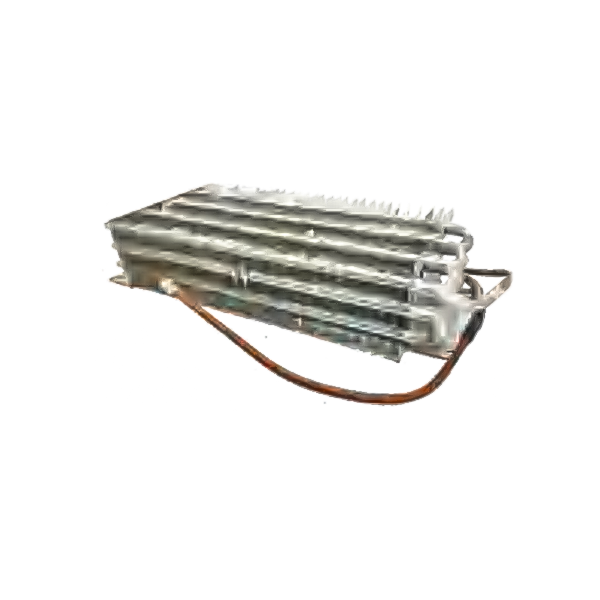 Aluminum Tube Fin-Type Evaporators for No-Frost RefrigerationThis product listing covers aluminum tube fin-type evaporators, which are commonly used in no-frost designs. The range of models (126-133) allows comparison of configurations, aiding in selection for compatibility with existing cabinets.View Product →
For procurement, the construction type affects both unit cost and compatibility with the cabinet. The table below compares the two most common aluminum evaporator architectures in household and commercial refrigeration.
| Feature | Wire-Tube Evaporator | Fin-Type Evaporator |
|---|---|---|
| Primary structure | Aluminum tube wound around steel wires | Aluminum tubes with stamped aluminum fins |
| Airflow | Natural or static circulation | Forced fan circulation |
| Frost management | Defrost heater or manual operation | Designed for automatic defrost cycles |
| Typical applications | Small refrigerators, cellar coolers | No-frost freezers, display cases |
| Relative cost | Lower | Higher |
Fin spacing is the detail that most buyer specifications miss. In a freezer that cycles between -18°C and -25°C, fin spacing of 4 mm to 6 mm allows frost to form without immediately starving airflow. If the same evaporator goes into a high-humidity environment, a tighter spacing of 3 mm will clog faster and increase the defrost interval. When ordering a replacement, match the fin pitch to the original design rather than assuming denser fins always perform better.
Tube wall thickness matters just as much. A standard aluminum tube used in evaporators is often 0.7 mm to 0.9 mm before bending, and it can thin by 15 percent at the outside bend radius. A 0.5 mm wall may work in a small refrigerator but is a poor choice for a large commercial display case where vibration and expansion stress are higher. Ask the supplier for a cross-section sample and the bend thinning allowance before mass production. The relationship between thermal design and geometry deserves review early in the project. Fin-type evaporator design and selection considerations belong in the specification review.
Copper has a deserved reputation for corrosion resistance, but that reputation depends on the environment. Inside a clean, sealed, dry refrigeration loop, neither aluminum nor copper sees serious corrosive attack. Problems appear when atmospheric moisture enters the system, usually through a poorly brazed joint or during a repair. Aluminum forms a passivating oxide layer that protects the base metal, but chloride ions from coastal air or cleaning chemicals can break through that layer.
| Property | Aluminum Evaporator | Copper Evaporator |
|---|---|---|
| Thermal conductivity | ~237 W/m·K | ~400 W/m·K |
| Corrosion resistance in closed system | Good | Excellent |
| Resistance to chlorides | Moderate | Good |
| Weight per meter of tube | Lower, about 38% of copper | Higher |
| Ease of brazing and repair | Requires special filler and flux | Easier with standard HVAC practices |
| Material cost | Lower | Higher |
Field repair experience shows that aluminum evaporator leaks often occur at hairpin bends and tube-to-fin interfaces, not on straight tube passes. When the tube is expanded to lock the fins, microcracks can form if the temper is too hard. For this reason, tube temper is a material detail worth specifying. A half-hard temper balances strength and ductility for typical evaporator forming. Softer annealed tubes form easily but may not hold their shape under vibration, while full-hard tubes can crack during expansion.
A common misconception is that aluminum evaporators always require an anti-corrosion coating. In a typical hermetically sealed refrigerator, coatings are unnecessary because the refrigerant loop stays dry and contains no free water. The exception is a system exposed to high humidity, outdoor installation, or a heat-pump cycle where the evaporator becomes the condenser for part of the year. In those cases, an anodized or polymer coating adds meaningful protection. Specifying coatings for every application adds cost without extending life where they are not needed.
Buying an aluminum evaporator is not the same as buying a standard pipe fitting. The part must match the cabinet cavity, compressor displacement, refrigerant charge, and defrost cycle. The following checklist captures the key parameters to include in an RFQ.
These points sound technical, but they prevent the most common purchasing mistakes. A buyer who compares only price per kilogram will usually receive a thinner wall and denser fins, which increases stress corrosion risk and reduces defrost effectiveness. A buyer who specifies performance criteria and manufacturing process limits will get a consistent product across multiple batches. From a maintenance standpoint, condenser maintenance also affects the load on the evaporator, because a dirty condenser raises pressure and forces the evaporator to run colder than intended.
The quality of an aluminum evaporator is determined before the first stamping die hits the fin coil. When a manufacturer controls alloy sourcing, tube drawing, fin stamping, assembly, and leak testing in one facility, the tolerance stack is short and traceable. A supplier that only assembles purchased fins and tubes has less control over the interface between the two parts.
Suzhou Yikangda Electrical Appliance Co., Ltd. has produced refrigeration evaporators and condensers since 1992. The company is ISO9001 certified, operates from a facility near Shanghai, and ships fin-type aluminum tube evaporators to appliance makers in the U.S., Europe, Southeast Asia, and other markets. For a buyer evaluating suppliers, in-house production matters because the fin density, tube temper, and joint quality are controlled by the same team across each product line.
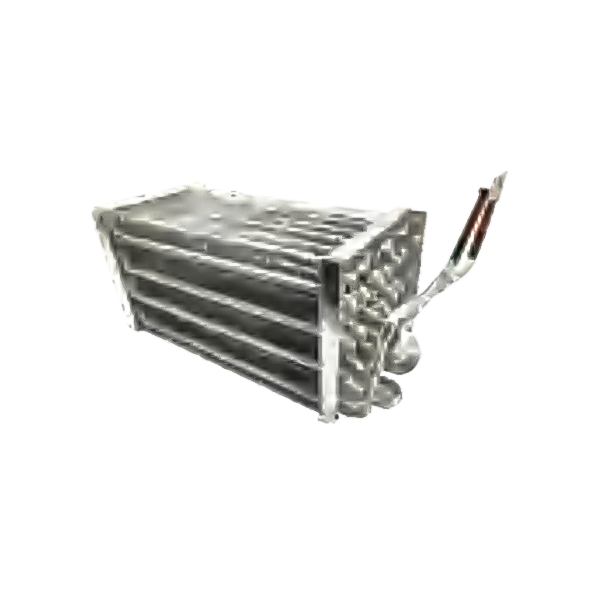 126 Fin Type Evaporator with Aluminum TubesThis model exemplifies in-house production quality, with features like slant insertion of all-aluminum fins and length under 600mm. It serves as a test case for evaluating supplier responsiveness to design specifications and technical feedback.View Product →
One useful way to assess a potential supplier is to send a drawing with deliberately aggressive bend radii and see how the factory responds. An experienced manufacturer will request a revised bend radius to prevent tube thinning or will offer a different alloy with slightly lower conductivity but better formability. A less experienced factory will accept the drawing without comment, which sets up a higher field failure rate. This type of technical pushback indicates that the supplier has actually tested the design.
An aluminum evaporator is a mature component, but the difference between a good one and a bad one is not immediately visible under a quick visual inspection. It shows up in the consistency of fin spacing, the uniformity of tube wall thickness, the cleanliness of joints, and the supplier’s willingness to discuss test data. Buyers who focus on those details shorten the qualification cycle, reduce field failures, and avoid redesigning a cabinet around a poorly manufactured part. When the specification, the material, and the manufacturing process align, an aluminum evaporator can outlast the compressor and the electronics around it.
Your email address will not be published. Required field are marked*

No.380 Kangyang Rd in the north,HuangdaiTown,Xiangcheng District,Suzhou City,215143

0512-65481378


